
Arm Workout: The Best Biceps and Triceps Exercises and a Twice-a-Week Plan
GYMDONE editorial team
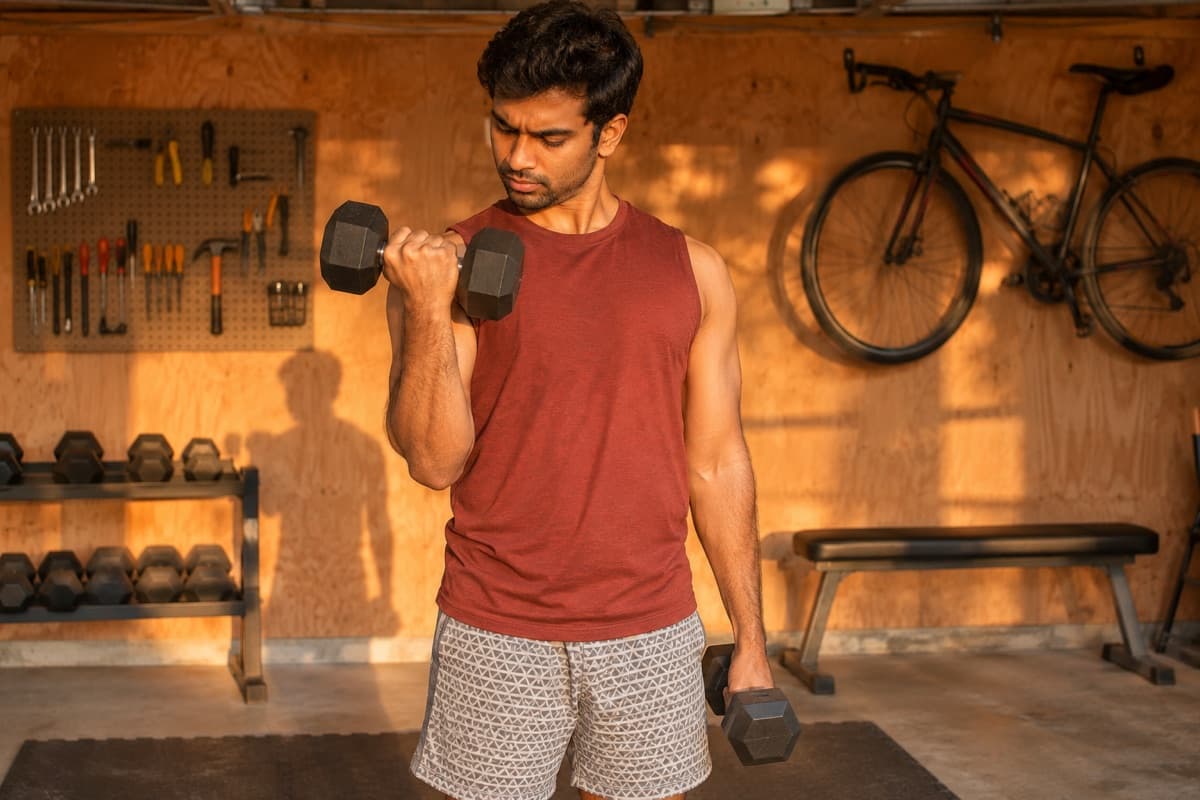
A good arm workout has two halves. For the biceps side: one curl with the palms up and one with a neutral or overhand grip. For the triceps: one heavy press and one extension with the arm overhead. Do 2–3 sets of each, mostly 8–15 reps, twice a week, and add weight when every set reaches the top of the range.
That's four exercises, about 30 minutes. A gym with a barbell and cables is fine for this, and so is a pair of dumbbells at home. No weights at all? Chin-ups and close push-ups still do the job.
What the arm muscles do
The front of the upper arm bends the elbow. Three muscles share that work. The biceps has two heads, and besides bending the elbow it turns the palm up. So it works hardest in a palms-up curl. Under it lies the brachialis, which bends the elbow whatever the grip. The brachioradialis runs along the top of the forearm and takes more of the load when the palm faces in or down. That's why a hammer curl feels different from a regular one.
The back of the arm is the triceps, and it's the bigger of the two. It has three heads and straightens the elbow. Two heads cross only the elbow. The third, the long head, starts on the shoulder blade, so it's stretched when the arm goes up over the head.
That stretch matters. In a 12-week study, 21 adults trained cable extensions twice a week, one arm overhead and the other with the elbow at the side. The overhead arm used lighter weights, yet its triceps grew by 19.9% against 13.9% (Maeo et al., 2023). So every arm plan should have one overhead extension in it. If pushdowns are all you do, the long head gets short-changed.
The best arm exercises by movement
Pick one exercise from each of the first four rows. Rows five and six are extras. Add them on a second arm day, or skip them.
| Movement | Gym | Dumbbells or home | Sets × reps |
|---|---|---|---|
| Palms-up curl (biceps) | or | or | 3 × 8–12 |
| Neutral-grip curl (brachialis, forearm) | 2–3 × 10–12 | ||
| Heavy press (whole triceps) | or | or | 3 × 6–10 |
| Overhead or lying extension (long head) | or | or | 3 × 10–15 |
| Second curl | or | 2 × 10–15 | |
| Pushdown and forearms | , | , | 2 × 12–15 |
Do you need curls at all if you already do rows and pull-ups? At the start, maybe not. In one study, 29 untrained men did either lat pulldowns or biceps curls twice a week for ten weeks. The front of the arm got about 6% thicker in both groups (Gentil et al., 2015). Pulling trains the biceps, pressing trains the triceps. Curls and extensions become worth the time later on, once the big lifts stop being enough. Or right away, if bigger arms are the whole point for you. We go deeper into this in compound vs isolation exercises.
Barbell, dumbbells or cable? Any of them works. A straight bar lets you load the most. If it bothers your wrists, switch to an EZ bar or dumbbells. Cables keep tension at the top of a curl, where a dumbbell gets easy. Training at home? Our dumbbell exercises list has more to choose from.
An arm workout plan for two days a week
Two sessions follow, and a no-weights one for travel or home. Most people run A and B as short arm days of their own, at least 48 hours apart. On an upper/lower split you don't need a separate day: finish each upper session with one curl and one extension from the table. A push/pull/legs routine is the same idea, with curls on pull day and triceps on push day. Rest 2 minutes after presses and chin-ups and 60–90 seconds after curls and extensions.
- Arm day A (gym)3 × 8–103 × 6–103 × 10–123 × 10–152 × 10–122 × 12–15
- Arm day B (dumbbells at home)3 × 8–123 × 10–123 × 10–123 × 10–122 × 12–152 × 8–15
- Arm day without weights3 × 5–103 × 8–153 × 8–123 × 10–15
Day A is 8 sets for the front of the arm and 8 for the back. Do it twice and you get 16 direct sets a week for each. That's plenty, because your back workout and chest workout add more on top. Training a muscle twice a week has beaten once a week for growth when the weekly work was the same (Schoenfeld, Ogborn and Krieger, 2016). A year later the same team showed that, up to a point, extra weekly sets bring extra growth (2017 meta-analysis). If you're new, start with 2 sets per exercise and skip the last two exercises. Not sure whether a bench press set counts for triceps? Training volume per muscle sorts that out.
How to make progress
Arms are small muscles, and the weights move slowly. Going from 10 kg to 12 kg dumbbells is a 20% jump. Nobody adds that in a week. So use reps first. Take a range, say 10–12. Stay with one weight until all sets reach 12 clean reps, then move up and start again from 10. If the next pair is too heavy, add a set or lower each rep for three seconds. That's still progressive overload.
Write the numbers down. A curl that goes from 3 × 10 to 3 × 12 over a month looks like nothing in the mirror, but in a workout log it's clear progress. A tape measure helps too. Measure the upper arm at its widest point, relaxed, once a month, at the same time of day.
Common mistakes
- Swinging the weight. If your hips and back start the curl, the biceps gets less of it. Keep your elbows by your ribs and pick a lighter weight.
- Cutting reps short. Let the arm go straight at the bottom of a curl, and bend the elbow all the way in an extension. A lot of the growth comes from that stretched part of the rep.
- Flaring elbows in extensions. When the elbows drift wide, the move turns into a press. Point them forward (or at the ceiling if you're lying down).
- Forgetting the triceps. Most of the arm is triceps. It should get at least as many sets as the biceps.
- Arms every day. Your arms already work on back and chest days, so twice a week of direct work is enough. Leave a day or two in between.
Common questions
How often should I train arms?
Twice a week works for most people, either as short arm days or as two or three exercises added after upper-body training. Leave at least 48 hours between them.
Can I build arms at home with dumbbells only?
Yes. Curls, hammer curls and overhead extensions cover everything. Once the dumbbells feel light, slow the lowering, add reps up to about 20, or work one arm at a time.
How long until my arms look bigger?
Strength goes up within a few weeks. A visible change usually takes two to three months of steady training and enough food and protein. In the studies above, arm muscles grew by roughly 6–20% over 10–12 weeks.
My elbows hurt during skull crushers. What should I do?
Swap them for a cable or dumbbell overhead extension, use lighter weight and more reps, and warm up with two easy sets. If the pain stays, see a doctor or physiotherapist.
Sources
- Maeo S, Wu Y, Huang M, Sakurai H, Kusagawa Y, Sugiyama T, Kanehisa H, Isaka T. Triceps brachii hypertrophy is substantially greater after elbow extension training performed in the overhead versus neutral arm position. Eur J Sport Sci, 2023
- Gentil P, Soares S, Bottaro M. Single vs. Multi-Joint Resistance Exercises: Effects on Muscle Strength and Hypertrophy. Asian J Sports Med, 2015
- Schoenfeld BJ, Ogborn D, Krieger JW. Effects of Resistance Training Frequency on Measures of Muscle Hypertrophy: A Systematic Review and Meta-Analysis. Sports Med, 2016
- Schoenfeld BJ, Ogborn D, Krieger JW. Dose-response relationship between weekly resistance training volume and increases in muscle mass: A systematic review and meta-analysis. J Sports Sci, 2017