
Gym Exercises List: 42 Moves by Equipment and How to Use Them
GYMDONE editorial team
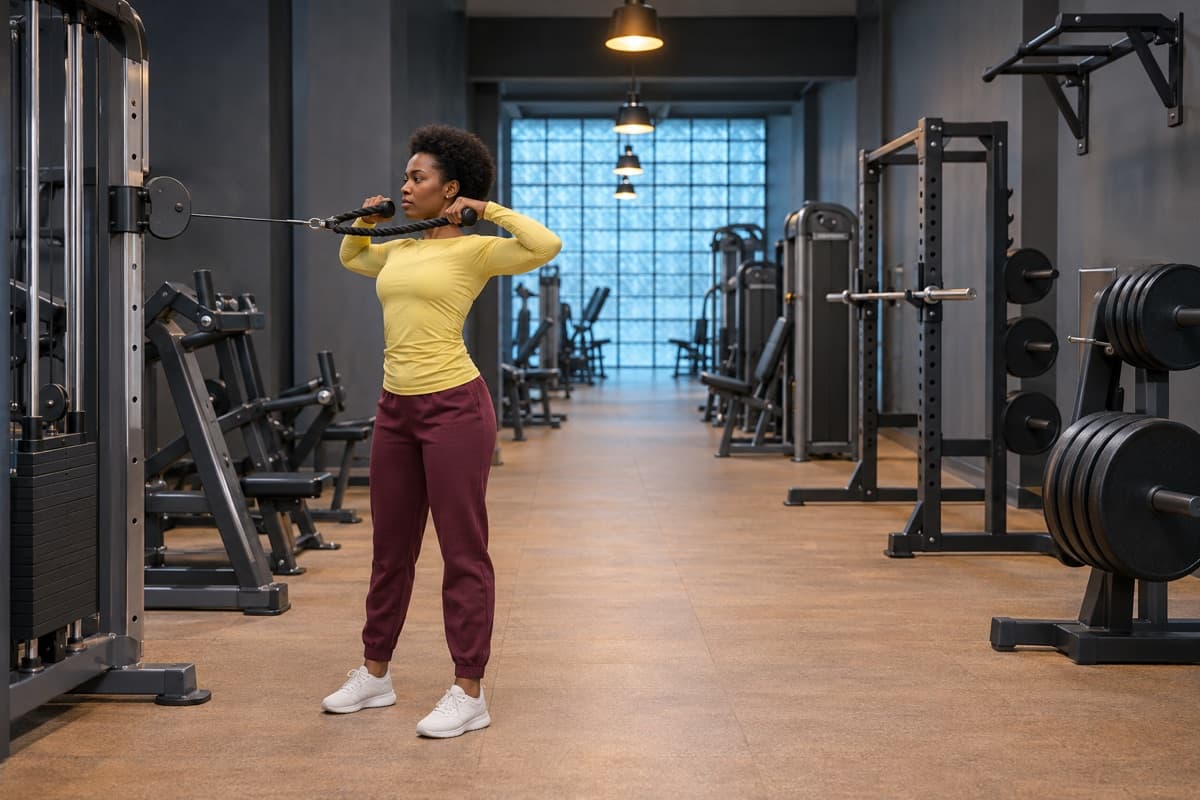
A useful list of gym exercises is shorter than the gym makes it look. Around forty moves cover everything most people will ever need, and they sort neatly by equipment: barbells, cables, machines and your own body weight. Dumbbells have a list of their own. You don't need all forty. Pick one exercise for each basic movement, train it two or three times a week, and add weight as you get stronger.
Below are the four lists, with the muscles each move works and a short tip. Then a two-day workout built from them, so you can see how it fits together.
How to read this list
Nearly every gym exercise is a version of six movements: squat, hinge (bending at the hips, as in a deadlift), push, pull, single-leg work and bracing your trunk. Arm, shoulder and calf exercises fill the gaps. For a session, take one move from each of the first four groups and finish with one or two extras.
Order matters a little. The American College of Sports Medicine advises doing exercises for large muscle groups before small ones, and multi-joint lifts before single-joint ones (ACSM, 2009). So squats and rows go first, while you're fresh, and curls wait until the end. If you want the logic behind that split, see compound vs. isolation exercises. For a muscle-by-muscle view instead of an equipment one, the muscle groups guide has it.
Barbell exercises
You can put more weight on a barbell than on anything else here, and the plates go up in 2.5 kg steps. Technique matters more, though. Start light and film a set now and then.
| Exercise | Main muscles | Good to know |
|---|---|---|
| Quads, glutes | Set the bar in a rack with safety pins at the right height. | |
| Glutes, hamstrings, back | Bar over the middle of the foot, back flat, push the floor away. | |
| Hamstrings, glutes | Lower until you feel a stretch, not until the bar hits the floor. | |
| Glutes | A pad on the bar saves your hips. | |
| Chest, front delts, triceps | Use a spotter or safety arms once sets get hard. | |
| Upper chest, shoulders | A low incline of 15–30° is plenty. | |
| Triceps, chest | Hands about shoulder-width, elbows close to the body. | |
| Shoulders, triceps | Squeeze your glutes so your lower back doesn't arch. | |
| Upper back, lats | Keep the torso still; if it bobs, the weight is too heavy. | |
| Biceps | Elbows stay at your sides the whole time. |
Cable exercises
Cables pull on the muscle the whole way, top to bottom. Changing the weight means moving a pin. With a high and a low pulley you can do everything in this table.
| Exercise | Main muscles | Good to know |
|---|---|---|
| Lats, biceps | Pull to the upper chest, not behind the neck. | |
| Mid back, lats | Sit tall and pull the handle to your belly. | |
| Rear delts, upper back | Rope at eye level, pull the ends apart toward your ears. | |
| Lats | Arms nearly straight; a good warm-up for pull-ups. | |
| Chest | Bring the hands together in front of the lower chest. | |
| Side delts | Light weight, one arm at a time. | |
| Triceps | Only the forearms move. | |
| Triceps, long head | Face away from the stack and press the rope forward and up. | |
| Biceps | Tension stays on even at the top, unlike a dumbbell. | |
| Abs | Curl your spine down; don't just bow from the hips. | |
| Obliques, deep core | Press the handle out and don't let the cable twist you. | |
| Side glutes | Ankle strap, small slow lifts out to the side. |
Machine exercises
On a machine the path is fixed and balance stops being your problem, so you can push hard. Good for beginners, and for anyone training alone. Set the seat so the joint lines up with the machine's pivot, usually marked with a dot. The gym machine workout covers setup in more detail.
| Exercise | Main muscles | Good to know |
|---|---|---|
| Quads, glutes | Lower back stays on the pad at the bottom. | |
| Quads | Feet lower on the platform hit the quads more. | |
| Quads | Pause for a second at the top. | |
| Hamstrings | Lock the thigh pad down tight. | |
| Chest, triceps | Handles at mid-chest height. | |
| Shoulders, triceps | Handles start around chin level. | |
| Chest | Slight bend in the elbows, slow on the way back. | |
| Rear delts | Same machine, facing the pad. | |
| Lats, biceps | More weight on the stack means more help. | |
| Lower back, glutes | Move slowly and stop when your body is straight. | |
| Calves | Full stretch at the bottom, brief pause. | |
| Calves (soleus) | Knees bent shifts the work to the lower calf. |
Bodyweight exercises in the gym
Every gym has a pull-up bar, a dip station and some floor, and there's rarely a queue. Add a weight belt or a dumbbell between the feet once sets of 12 are easy.
| Exercise | Main muscles | Good to know |
|---|---|---|
| Lats, upper back | Can't do one yet? Start with the assisted machine. | |
| Lats, biceps | Palms facing you; most people find it easier than the pull-up. | |
| Upper back | Bar in a rack at hip height. The lower the bar, the harder it gets. | |
| Chest, triceps | Body in one straight line from head to heels. | |
| Chest, triceps | Lean forward a little and stop if your shoulders complain. | |
| Abs, hip flexors | Curl your pelvis up rather than swinging. | |
| Abs | Start from your knees and roll only as far as you can control. | |
| Abs, deep core | Squeeze glutes and fists; 20–40 seconds of real effort beats two minutes of sagging. |
Free weights or machines?
Both work. A 2023 meta-analysis of 13 studies with 1,016 people compared the two directly and found no difference in strength gains, jump height or muscle growth (Haugen et al., 2023). Practice did show, though. Free-weight groups improved more when tested on free weights, and the machine groups leaned the other way. If a heavier squat is your goal, squat.
Big lifts against small ones is a similar story. For ten weeks one group of untrained men trained their arms with nothing but lat pulldowns, another with nothing but curls. Biceps thickness went up 6.1% and 5.8% (Gentil et al., 2015). The authors' takeaway: pick by equipment, preference and the time you've got. Treat this list the same way.
A two-day workout from the list
Below, the tables become two real sessions. Main lifts on the barbell, the rest on cables and machines, days taken in turn. Rest one to two minutes between sets, longer on the first lift.
- Day A3 × 6–83 × 6–83 × 10–122 × 10–122 × 12–153 × 30 s
- Day B3 × 8–103 × 6–83 × 8–122 × 10–122 × 10–152 × 10–15
Training three days a week, you'd go A, B, A, then B, A, B the week after. Squat rack taken? Swap in the leg press or the hack squat and carry on; that's what the lists are for. When you're ready for four or more days, the workout split guide shows how to divide the same exercises across the week. New to all of this? Read your first time at the gym before you go.
How many exercises and sets you need
Four to six exercises a session is enough. What matters more is the number of hard sets each muscle gets over a week. A meta-analysis of 15 studies found that more weekly sets led to more growth, with each extra set adding a little, and groups doing 10 or more sets per muscle tended to grow most (Schoenfeld et al., 2017). Beginners grow on less. Start near the low end and add sets only when recovery is easy. Training volume per muscle explains how to count them.
Stick with the same exercises for at least six to eight weeks. Changing them every session feels fresh, but you can't tell if you're getting stronger. Log the weight and reps, and when you hit the top of the rep range on every set, add a little load. The progressive overload guide covers what to do when that stalls.
Common questions
What are the best gym exercises for beginners?
Machines and cables are the easiest place to start: leg press, machine chest press, lat pulldown, seated cable row, seated leg curl and a plank. Add a barbell or dumbbell version of each movement after a few weeks.
How many exercises should I do per workout?
Four to six, covering a squat, a hinge, a push and a pull, plus one or two smaller moves. More than eight usually means each one gets less effort.
Do I need to use every exercise on this list?
No. The list is a menu. Most strong people do the same eight or ten exercises for years and change them only when they stop progressing or get bored.
Are cables better than free weights?
Neither is better for muscle growth. Cables are handy for keeping tension and for small muscles like the side delts; free weights are better practice if you want to get strong at barbell lifts.
Sources
- American College of Sports Medicine. Progression models in resistance training for healthy adults. Med Sci Sports Exerc, 2009.
- Haugen ME, et al. Effect of free-weight vs. machine-based strength training on maximal strength, hypertrophy and jump performance. BMC Sports Sci Med Rehabil, 2023.
- Gentil P, Soares S, Bottaro M. Single vs. multi-joint resistance exercises: effects on muscle strength and hypertrophy. Asian J Sports Med, 2015.
- Schoenfeld BJ, Ogborn D, Krieger JW. Dose-response relationship between weekly resistance training volume and increases in muscle mass. J Sports Sci, 2017.