
Leg Workout: The Best Leg Exercises and a Twice-a-Week Plan
GYMDONE editorial team
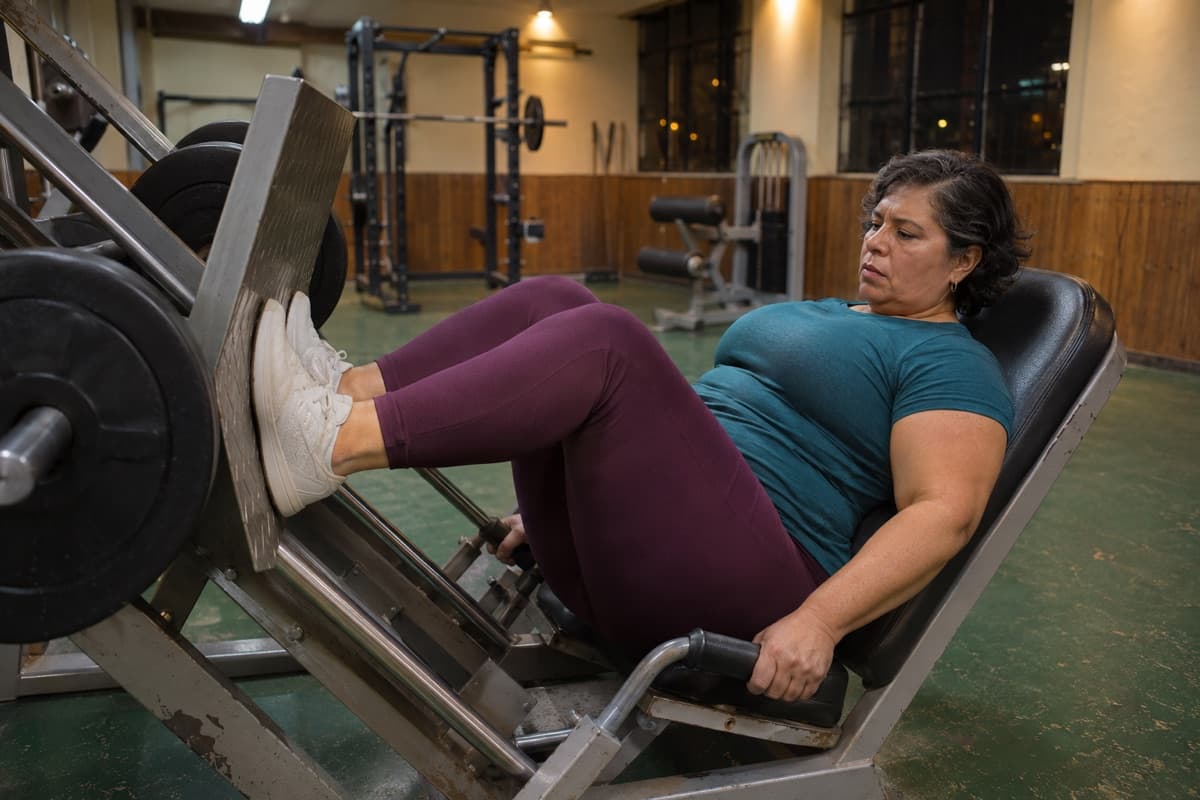
A full leg workout comes down to four moves. Squat or leg press for the front of the thigh. A hip hinge (the Romanian deadlift, usually) for the back of it. One single-leg exercise, like a split squat. And a calf raise. Do 3 sets of each for 6–15 reps, twice a week. Once all your sets reach the top of the range, add weight.
In a gym that's 40–50 minutes. At home, two dumbbells are enough for the same four moves. No weights at all? Scroll down, we've got a version for that.
What the leg muscles do
The quadriceps sit on the front of the thigh, four muscles that straighten the knee. Three of them start on the thigh bone. The fourth, the rectus femoris, starts up on the pelvis, so it crosses the hip too.
The hamstrings run down the back of the thigh. They bend the knee, and most of them also pull the hip straight. That gives you two ways to train them: a hinge, where the hip moves, and a curl, where the knee moves.
The calf is two muscles. The gastrocnemius is the one you see. It crosses the knee. The soleus lies under it and doesn't. On the inner thigh are the adductors, and they work hard at the bottom of a deep squat.
Depth matters here. In a ten-week study, 17 men squatted twice a week, to full depth or only halfway. The front of the thigh grew about 5% in both groups. The glutes and adductors grew by 6–7% with full squats and by 2–3% with half squats. The rectus femoris and the hamstrings didn't grow in either group (Kubo et al., 2019). Two things follow. Squat as deep as you can control. And squats won't do it all. Hamstrings need exercises of the hinge or curl kind.
The best leg exercises by movement
Take one exercise from each of the first four rows. The last two rows are isolation work for the gym, or for a longer session at home.
| Movement | Gym | Dumbbells or home | Sets × reps |
|---|---|---|---|
| Squat or press (quads, glutes, adductors) | ,or | or | 3 × 6–10 |
| Hip hinge (hamstrings, glutes) | or | 3 × 8–12 | |
| Single leg (quads, glutes, balance) | or | ,or | 3 × 8–12 per leg |
| Calf raise | or | 3 × 10–15 | |
| Knee extension (rectus femoris) | 2–3 × 12–15, wall sit 30–45 s | ||
| Leg curl (hamstrings) | or | 2–3 × 10–15 |
Seated or lying leg curl? If your gym has both, sit down. In one study 20 adults trained one leg on the seated machine and the other on the lying one, twice a week for 12 weeks. Hamstring size went up 14% on the seated side, 9% on the lying side (Maeo et al., 2021). Sitting bends the hip, and that puts the hamstrings on a stretch while they work.
The same lab tested calves in 2023. Fourteen adults did standing raises with one leg and seated raises with the other. Twelve weeks later the two heads of the gastrocnemius were 12.4% and 9.2% bigger on the standing leg. On the seated leg: 1.7% and 0.6%. For the soleus it made no real difference (Kinoshita et al., 2023). So train calves standing, knees straight. I'd treat the seated machine as optional.
Barbell or machines? Both build legs. A leg press is quicker to learn, and there's nothing to balance. In your first months that counts for a lot. Our gym machine workout has a full plan built that way.
A leg workout plan for two days a week
You get two gym days here, a home day with dumbbells, and one with no weights. Keep 48–72 hours between leg days. On an upper/lower split, days A and B are your two lower sessions. In a push/pull/legs routine, pick one of them for legs day, or alternate. Reps for lunges, split squats and single-leg calf raises are per leg.
Walk or pedal for five minutes first. Then two or three lighter sets of your first lift (more in warm-up before lifting). After squats, presses and Romanian deadlifts, rest 2–3 minutes. For curls, extensions and calf raises 60–90 seconds will do.
- Leg day A (gym)3 × 6–83 × 8–103 × 10–123 × 10–153 × 10–15
- Leg day B (gym)3 × 8–103 × 8–103 × 10–123 × 12–153 × 12–15
- Leg day at home (dumbbells)3 × 10–123 × 10–123 × 8–103 × 8–123 × 10–15
- Leg day without weights3 × 10–153 × 10–123 × 10–153 × 8–123 × 10–15
A and B together give the quads about 15 sets a week, the hamstrings 9 and the calves 6. Hamstrings behind? Put one more set on each curl. Why two days and not one long one? Muscles trained twice a week have grown more than muscles trained once, even with the weekly work kept equal (Schoenfeld, Ogborn and Krieger, 2016). And the last sets of a 25-set leg day are never good ones.
New to this? Start with 2 sets per exercise and stop after the first four. If you aren't sure which muscle a set counts for, training volume per muscle explains it. The glutes already work in every squat, hinge and lunge here. For more direct work, hip thrusts for example, see the glute workout.
How to make progress
Legs are big muscles, and the weights go up faster than they do for arms. Take a range, say 6–8 on the squat. Stay with one weight until all three sets reach 8 clean reps, then add 2.5–5 kg and start again from 6. That's progressive overload in its plainest form.
At home the dumbbells run out sooner. When the goblet squat gets easy, don't just pile on reps. Move to the split squat, then the Bulgarian split squat, so one leg carries most of the load. Lower for three seconds. Pause for a second at the bottom.
Write every session down. A leg press that moves from 100 kg to 120 kg in two months is hard to see in the mirror, and in a workout log you can't miss it.
One warning. After the first leg days your thighs will be sore for two or three days, and stairs won't be fun. That's normal. Give it a couple of weeks and it stops happening. Starting with 2 sets keeps it bearable.
Common mistakes
- Squatting too shallow. Half squats let you load more plates, but the glutes and inner thighs get much less out of them. Take weight off and go as low as you can with your heels down and your back flat.
- Skipping the hamstrings. Squats and leg presses barely train them. Every leg day needs a hinge or a curl, and better both.
- Knees falling inward. On the way up, push your knees out so they track over your toes. If they still cave, the weight is too heavy.
- Bouncing calf raises. Short, fast reps let the tendon do the work. Go all the way down, hold the stretch for a second, then rise as high as you can.
- Cutting leg day when you're busy. Half your muscle is below the waist. Short on time? Keep the squat and the Romanian deadlift and drop the rest.
Common questions
How often should I train legs?
Twice a week suits most people. Keep two or three days between sessions. Once a week still works if that's all your schedule allows. Progress will just be slower.
Can I build legs at home without a barbell?
Yes. Goblet squats, split squats, Romanian deadlifts with dumbbells and single-leg calf raises cover every muscle. When they feel light, switch to single-leg versions and slow the lowering.
Leg press or squat?
Either. Quads and glutes get trained well by both. The squat asks more of your balance and your back. On the leg press it's simpler, and safer, to push close to failure. Day A above has both, and so do lots of plans.
My knees hurt when I squat. What should I do?
Take weight off first. Squat only as deep as feels fine, and try a box squat or the leg press for a few weeks. Two easy warm-up sets help too. Pain that doesn't go away is a reason to see a doctor or physiotherapist.
Sources
- Kubo K, Ikebukuro T, Yata H. Effects of squat training with different depths on lower limb muscle volumes. Eur J Appl Physiol, 2019
- Maeo S, Huang M, Wu Y, Sakurai H, Kusagawa Y, Sugiyama T, Kanehisa H, Isaka T. Greater Hamstrings Muscle Hypertrophy but Similar Damage Protection after Training at Long versus Short Muscle Lengths. Med Sci Sports Exerc, 2021
- Kinoshita M, Maeo S, Kobayashi Y, Eihara Y, Ono M, Sato M, Sugiyama T, Kanehisa H, Isaka T. Triceps surae muscle hypertrophy is greater after standing versus seated calf-raise training. Front Physiol, 2023
- Schoenfeld BJ, Ogborn D, Krieger JW. Effects of Resistance Training Frequency on Measures of Muscle Hypertrophy: A Systematic Review and Meta-Analysis. Sports Med, 2016