
Workout Timer: How to Time Rest, Supersets and EMOM
GYMDONE editorial team
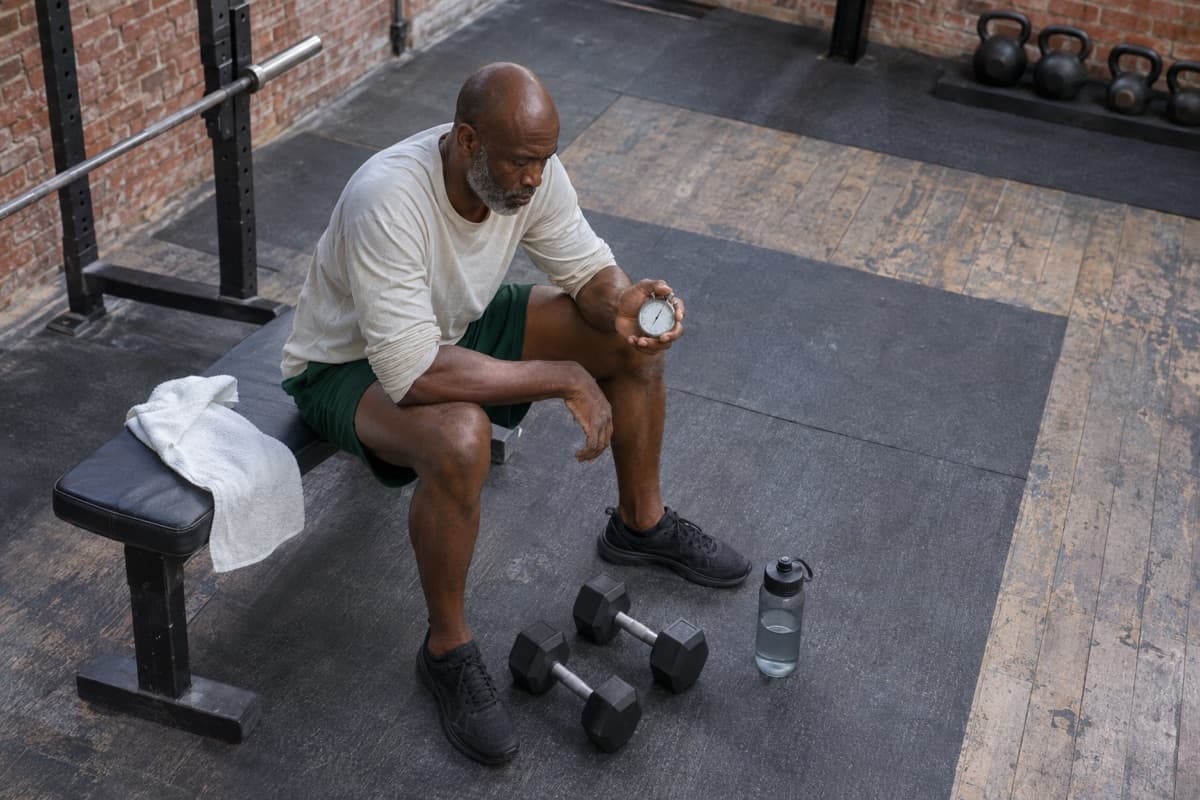
In strength training a workout timer has one real job. It keeps your rest between sets the same every time. Start it the second a set ends. Give yourself 2–3 minutes after heavy squats, presses and rows, and 60–90 seconds after curls and raises. When it beeps, you lift.
The other modes you can live without. A stopwatch tells you how long the session ran. An interval timer can run supersets, EMOM blocks and home circuits. Below you'll find the settings for each one. Further down there's a full 45-minute session for the gym.
Which workout timer mode does what
Phone clocks and gym timer apps mostly offer the same five modes. On a normal lifting day I use two: the rest countdown and the stopwatch.
| Mode | What it does | Use it for | Typical setting |
|---|---|---|---|
| Rest countdown | Counts down and beeps at zero | Straight sets of any lift | 1:00–3:00 |
| Stopwatch | Counts up | The whole session, or a rest you want to measure | No setting |
| EMOM (every minute on the minute) | Beeps at the top of each minute | Accessory lifts, bodyweight circuits | 6–10 minutes, one set a minute |
| Interval (work/rest) | Switches between two fixed times | Home circuits and holds such as the | 40 s work, 20 s rest |
| AMRAP countdown | One long countdown | A finisher: as many rounds as you can | 5–10 minutes |
Rest timer settings by exercise and goal
The reasons for these numbers are in rest between sets. Here you only get what to type into the timer.
| Exercise type | Examples | Strength, 1–5 reps | Muscle, 6–15 reps |
|---|---|---|---|
| Heavy barbell lifts | ,, | 3:00–5:00 | 2:30–3:00 |
| Other compound lifts | ,, | 2:00–3:00 | 1:30–2:30 |
| Isolation lifts | ,, | Rarely trained this heavy | 1:00–1:30 |
| Bodyweight and core | , | Not used | 0:45–1:00 |
Two studies are behind most of this. In the first, 21 trained men did the same full-body program three times a week for eight weeks. Half rested 1 minute between sets, half rested 3. The 3-minute group gained more strength in the squat and bench press, and the front of the thigh grew more (Schoenfeld et al., 2016).
The second is a 2024 review that pooled nine studies. Resting longer than 60 seconds gave a small edge for muscle growth. Past 90 seconds it couldn't find a clear difference (Singer et al., 2024). So for muscle, don't go under a minute. What you get from resting longer than that is mostly better heavy sets.
How to use a rest timer
- Start it when the set ends. Not after you've had a drink and found your towel. Otherwise a "2-minute" rest is really three and a half.
- Log the set straight away. Weight and reps, ten seconds, done. Then the phone goes face down.
- Get in position early. With 15 seconds left, walk to the bar and set your grip.
- Check yourself at the beep. Is your breathing calm? Could you come within a rep or two of your last set? If not, take 30 seconds more, and set the timer longer next week.
- Keep the same rest from week to week. Eight reps after 3 minutes and eight reps after 90 seconds aren't the same result. Your workout log only shows progressive overload when the rest stays put.
How to time supersets
A superset is two exercises back to back, and only then a rest. Pick two that don't share muscles: a press with a row, or an upper-body lift with a leg lift. Do the first. Walk to the second, which takes about 20 seconds. Do it. Now start the timer, 60–90 seconds.
What do you lose? Not much. A 2025 review of 19 studies with 313 people compared supersets with ordinary sets. Total reps came out the same and sessions were shorter. Strength and muscle growth over the following weeks were similar too. People did rate superset sessions as harder (Zhang et al., 2025).
The pairing matters. Opposing muscles kept the rep count up. Two exercises for the same muscle cut the work done. An earlier review put the saving at about half the training time for supersets, drop sets and rest-pause sets (Iversen et al., 2021). I'd still leave heavy squats and deadlifts out of supersets and give them a full rest.
EMOM and interval timers
EMOM means "every minute on the minute". Set a timer that repeats every 1:00. At each beep you do one set, and what's left of the minute is your rest. Pick a rep count that takes 20–30 seconds, so 30–40 seconds stay free. With two exercises, the first goes on odd minutes and the second on even ones.
There's a simple check. If a set runs past the 45-second mark, the reps are too high. Take two off. EMOM suits curls, pushdowns, pull-up practice and home circuits. For heavy lifts it's a poor fit, because the rest never reaches a minute.
An interval timer fixes the working time, 40 seconds on and 20 off for example. It's handy for planks and circuits at home. Count your reps in each round anyway and write them down. Otherwise you can't tell whether you did more than last week. For full home sessions, see the home workout plan.
A 45-minute gym session, timed
This is one full-body session that uses three timer modes. Start the stopwatch as you walk in. The first 5 minutes are a warm-up: easy cardio, then two lighter sets of squats inside block 1. Reps for the row are per arm.
- Block 1, rest countdown 2:30 (22 minutes)3 × 6–83 × 6–8
- Block 2, superset with 1:30 after each pair (10 minutes)3 × 10–123 × 10–12
- Block 3, EMOM for 8 minutes4 × 104 × 12
- At home, EMOM for 20 minutes5 × 105 × 8–125 × 6–85 × 30 s
The sums: 5 + 22 + 10 + 8 = 45 minutes. In block 1 a set takes about 40 seconds, so six sets and six rests come to 19 minutes, and the warm-up sets fill the other three. Block 3 gives you curls on odd minutes and pushdowns on even ones.
At home it's one exercise per minute. A round lasts four minutes and you do five of them. You don't need a bench or a barbell for it. One dumbbell and some floor will do.
How long should the whole session take?
Leave the stopwatch running and look at it when you finish. One number is enough. Did the same plan take 45 minutes last month and 65 today? Then something stretched. It's usually the rests, and usually the phone.
When you're short on time, don't cut every rest to 30 seconds. Drop a set from the small exercises, or pair them as supersets. The heavy lifts keep their full rest. There's a separate article on session length: how long a workout should take.
Common mistakes
- A Tabata timer for lifting. Twenty seconds on and ten off is a conditioning format. Ten seconds won't get you ready for another heavy set.
- Starting the clock late. If the timer starts a minute after the set, every rest is a minute longer than your log says.
- Racing the clock. Shorter rests each week aren't progress in strength training. More weight or more reps at the same rest is.
- Obeying the beep no matter what. The last set was a grinder and you're still out of breath? Take the extra 30 seconds. The timer is there to help. You're the one who decides.
- Timing nothing on small lifts. Rest on curls drifts the most. Nobody feels tired, so nobody watches the clock, and "a minute" turns into four.
Common questions
Do I need a special workout timer app?
No. The clock app on your phone has a countdown and a stopwatch, and that covers straight sets. A wall clock with a second hand works too. A dedicated timer helps once you want repeating beeps for EMOM or intervals.
Should the rest timer start at the end of the set?
Yes. Rest is the time between your last rep and your next first rep. Start it as you rack the weight.
What rest time is best for building muscle?
At least 60 seconds. For big compound lifts, 2–3 minutes lets you keep your reps up across sets. For small isolation lifts 60–90 seconds is enough.
Is EMOM good for building muscle?
It can be, for accessory and bodyweight exercises. The last rounds have to be hard, though. Finish them with one to three reps left in the tank (RPE and RIR explains how to judge that). If every round feels easy, add reps or weight.
Can I time planks and other holds?
Yes, and it beats counting in your head, because tired people count fast. Use interval mode: 30 seconds on, 30 off, three to five rounds. Once that's comfortable, go to 40 on and 20 off.
What if the gym is busy and I can't stick to the timer?
It happens most evenings. Somebody takes the bench, or you wait for a cable. Let the stopwatch run and write down the rest you really got. A long rest that's in the log still tells you something next week.
Sources
- Schoenfeld BJ, Pope ZK, Benik FM, et al. Longer Interset Rest Periods Enhance Muscle Strength and Hypertrophy in Resistance-Trained Men. J Strength Cond Res, 2016
- Singer A, Wolf M, Generoso L, et al. Give it a rest: a systematic review with Bayesian meta-analysis on the effect of inter-set rest interval duration on muscle hypertrophy. Front Sports Act Living, 2024
- Zhang X, Weakley J, Li H, et al. Superset Versus Traditional Resistance Training Prescriptions: A Systematic Review and Meta-analysis. Sports Medicine, 2025
- Iversen VM, Norum M, Schoenfeld BJ, et al. No Time to Lift? Designing Time-Efficient Training Programs for Strength and Hypertrophy: A Narrative Review. Sports Med, 2021